
Tag: Lean

  • Moving from Lean Training to Measurable Operational Results

    Moving from Lean Training to Measurable Operational Results

    Many organizations have trained dozens—or even hundreds—of employees in Lean methods and still struggle to show a meaningful operational return.

    People know the language. They can identify the eight wastes, build a process map, participate in a Kaizen event, and explain the basics of root-cause analysis. Certificates appear on office walls. Training completion looks impressive on a dashboard.

    Yet lead times remain long, recurring problems return, improvement ideas wait for decisions, and business leaders continue asking a reasonable question: What results did the training produce?

    The problem is rarely that Lean concepts have no value. The problem is that training was treated as the outcome rather than as preparation for better work. Knowledge becomes operational value only when people apply it to important problems, leaders remove barriers, and the organization measures whether performance actually improves.

    Training Is an Input, Not a Business Result

    Training can build vocabulary, confidence, and basic capability. It cannot, by itself, reduce defects, release capacity, improve delivery, or lower working capital. Those outcomes require changes to processes and management behavior.

    This distinction sounds obvious, but many improvement programs blur it. Their scorecards track:

    • Employees trained
    • Green Belts or facilitators certified
    • Kaizen events completed
    • Ideas submitted
    • Hours spent in workshops

    These are activity measures. They can help leaders understand whether capability-building work is occurring, but they do not prove that operations are better. A stronger system connects learning to measures such as yield, schedule adherence, changeover time, customer complaints, inventory, cost, safety risk, or decision speed.

    The purpose of Lean training is not to create people who can describe tools. It is to help people recognize problems, improve processes, and sustain better results.

    Why Lean Training Often Fails to Transfer

    Several predictable gaps prevent classroom learning from becoming measurable performance.

    The training is disconnected from business priorities

    Generic examples make concepts easier to teach, but learners often return to work without a clear connection between the method and the problems leadership needs solved. If the site is struggling with yield, service, or capacity, training should help participants work on those priorities—not on hypothetical processes with no operational consequence.

    Employees lack an immediate application

    Skills decay when they are not used. Someone who learns value-stream mapping but waits six months to facilitate a mapping session will need to relearn much of the method. Application should begin during or immediately after training, with a real problem and a named sponsor.

    Managers do not change their routines

    Employees may learn to expose waste and surface root causes, but their managers may continue rewarding firefighting, issuing solutions without investigation, or postponing decisions. If daily leadership behavior conflicts with the training, the management system wins.

    Projects are selected for convenience

    Certification programs sometimes encourage participants to choose projects that are easy to complete rather than important to the business. This produces completed templates and modest local wins, but little executive confidence in the improvement system.

    Benefits are declared but not verified

    A team may estimate savings from reduced labor time, scrap, or downtime without establishing a baseline or checking whether the gain appears in operating performance. When every project claims benefits but the financial and operational results remain unchanged, credibility erodes.

    A Five-Part System for Turning Learning into Results

    Organizations can close these gaps by managing Lean development as a performance system rather than a series of classes.

    1. Begin with the performance gap

    Before scheduling training, identify the operational gaps the organization must address. Examples include unstable output, excessive changeover time, recurring deviations, poor schedule attainment, long approval cycles, or high material loss.

    Then determine which skills are needed to address those gaps. A visible flow problem may call for observation, standard work, and Kaizen capability. A chronic variation problem may require measurement-system review and statistical analysis. Training should follow the problem portfolio.

    2. Pair every learner with a real application

    Each participant should have an opportunity to apply the new skill to a defined problem. The application does not need to be a large project. It does need a clear owner, baseline, target, scope, and review date.

    For example, a supervisor learning standard work might improve a daily line-start process. An engineer learning problem-solving might lead analysis of a recurring minor stoppage. A manager learning visual management might redesign a tier meeting around exceptions and decisions.

    This changes the question from “Did the employee complete the course?” to “Can the employee use the method effectively on real work?”

    3. Provide coaching at the point of use

    Classroom understanding is not the same as independent competence. People need coaching while defining problems, collecting data, testing causes, facilitating discussions, and building controls.

    Coaches should challenge the quality of the thinking, not complete the work for the learner. Useful questions include:

    • What evidence shows that this is the real problem?
    • How was the baseline established?
    • Which assumptions have not been tested?
    • Who must help design and sustain the change?
    • What measure will confirm that the result lasts?

    4. Integrate improvement into leadership routines

    Lean capability grows when leaders repeatedly ask about problems, evidence, ownership, barriers, and follow-through. Project reviews should be part of normal operating reviews, not separate events attended only by improvement specialists.

    Leaders also need to act. If a team has waited three weeks for a maintenance window, a data extract, or a cross-functional decision, more training will not help. Leadership must create the conditions in which trained employees can succeed.

    5. Measure transfer, results, and sustainment

    A useful measurement system has three levels:

    1. Capability: Can the learner demonstrate the method on real work?
    2. Operational result: Did the target measure improve against a credible baseline?
    3. Sustainment: Is the result still present after 30, 60, or 90 days, with ownership and controls in place?

    Financial benefits should be classified carefully. Cost avoidance, released capacity, productivity improvement, and budget reduction are not interchangeable. Operations and finance should agree on benefit definitions before projects begin.

    An Anonymized Manufacturing Example

    Consider a manufacturing operation that trained supervisors and technical staff in Lean fundamentals. Initial enthusiasm was high, but six months later the program could point only to workshop attendance and several small workplace-organization improvements.

    Leadership changed the approach. Instead of offering another broad training wave, the site identified three operational priorities: lengthy product changeovers, repeated line-start delays, and avoidable material loss. Participants were assigned to small teams aligned with those priorities, and each team received coaching during weekly project reviews.

    The changeover team separated work that required stopped equipment from preparation that could happen in advance. The line-start team clarified readiness criteria and ownership across production, quality, and materials. The material-loss team improved measurement and discovered that one assumed cause did not explain the variation.

    Not every idea worked, and not every benefit became a direct cost reduction. But the site could now connect training to verified changes in time, reliability, and loss. More importantly, supervisors began using the same problem-solving habits in daily work.

    The breakthrough was not a new Lean tool. It was a stronger connection among business priorities, real applications, coaching, management attention, and results.

    Common Implementation Risks

    • Overloading learners: Assigning a project without protecting time makes improvement an after-hours responsibility.
    • Forcing every problem into one method: Simple issues need less structure than chronic, high-risk problems.
    • Counting unverified savings: Inflated claims damage trust faster than modest, credible results build it.
    • Ignoring frontline ownership: Changes designed around operators rather than with them are difficult to sustain.
    • Ending support at certification: Capability develops through repeated application, reflection, and coaching.

    A Practical Scorecard

    Executives do not need dozens of improvement-program metrics. A concise scorecard can answer five questions:

    • What percentage of trained employees applied the skill within 30 days?
    • How many active applications address a stated business priority?
    • What operational measures improved against an agreed baseline?
    • Which benefits were verified by the appropriate functional owner?
    • What percentage of completed improvements sustained their result at the follow-up review?

    Training completion still matters, but it belongs at the beginning of the chain—not at the end.

    Lean training creates potential. A management system converts that potential into operating performance.
  • Just-Do-It vs DMAIC: When to Use Each Method

    Just-Do-It vs DMAIC: When to Use Each Method

    Improvement teams often make one of two mistakes. They use a complex method for a simple problem, or they rush into action when the problem requires deeper analysis.

    A loose guard needs repair, but someone proposes a full DMAIC project. A recurring yield loss affects several products, but the team schedules a one-day Kaizen event. A leader asks for an A3 because it is the standard template, even though the solution is already known and low risk.

    The method becomes the focus instead of the problem.

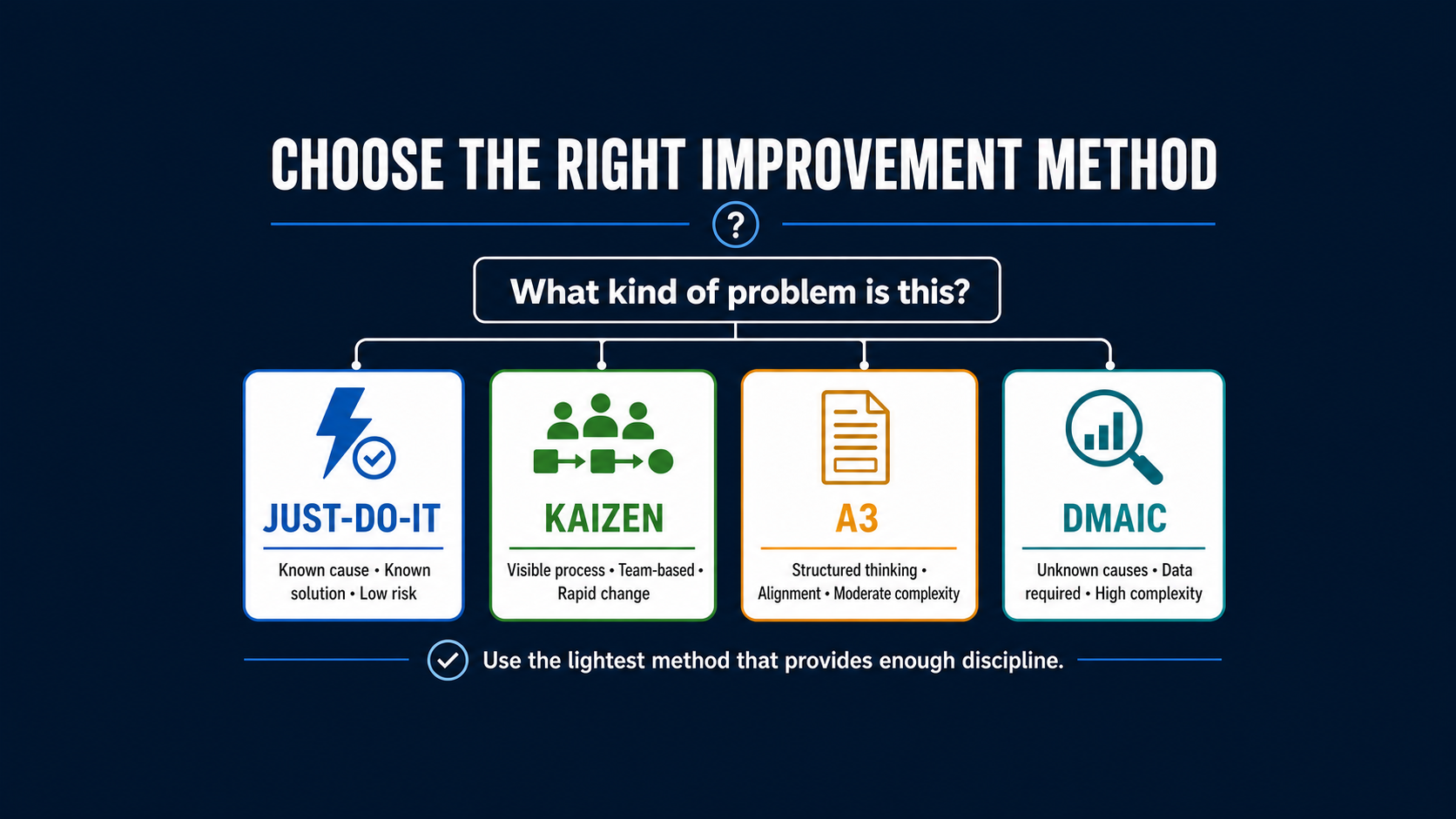
    Kaizen, DMAIC, A3, and Just-Do-It are not competing brands. They are different levels of structure for different types of problems. Choosing well improves speed, preserves rigor where it matters, and prevents teams from wasting energy on unnecessary process.

    Start with the Problem, Not the Preferred Tool

    Organizations often default to the method their internal experts know best. Lean teams may favor Kaizen. Six Sigma practitioners may prefer DMAIC. Some companies require A3s for almost every improvement. Frontline teams may simply implement the first practical idea.

    Each approach can work, but no single method fits every situation. The choice should reflect six characteristics:

    • How clearly the problem is defined
    • Whether the cause is known
    • Whether the solution is known
    • The level of risk and reversibility
    • The number of functions involved
    • The amount of data and analysis required

    A good rule is to use the lightest method that provides enough discipline to manage the problem safely and sustainably.

    Just-Do-It: When the Solution Is Clear and Low Risk

    A Just-Do-It improvement is a small, straightforward change with a known cause, an obvious solution, limited scope, and low implementation risk. It should not require a project team or extensive analysis.

    Examples might include replacing a damaged label holder, relocating a commonly used tool, clarifying a visual signal, correcting an outdated contact list, or changing the location of a non-controlled supply.

    Use Just-Do-It when:

    • The problem and cause are directly observable.
    • The solution is known and affordable.
    • The change is easy to reverse if it does not work.
    • Quality, safety, regulatory, technical, and customer risks are low.
    • One person or local team can implement and confirm the result.

    Simple does not mean uncontrolled. The owner should still check whether procedures, training, drawings, or approvals are affected. The change should also be documented enough that the organization does not repeatedly rediscover the same issue.

    Kaizen: When a Focused Team Can Improve a Process Quickly

    Kaizen means improvement. In practice, a Kaizen event is a focused, time-bound effort in which people who understand the work analyze a process, test changes, and establish a better method.

    It is useful when the problem is visible, the process can be observed, and rapid cross-functional collaboration can produce meaningful change. Common applications include reducing changeover time, improving workplace organization, simplifying material flow, improving line readiness, or removing delays in an administrative process.

    Use Kaizen when:

    • The process and boundaries are clear.
    • Waste, delay, motion, handoffs, or flow problems are visible.
    • The people doing the work can participate directly.
    • Changes can be tested within days.
    • Leadership can make timely decisions and provide resources.

    Kaizen is less suitable when root causes are uncertain, data must be collected over long periods, or the solution requires major capital, validation, or system redesign. An event can identify next steps, but it should not create false confidence that a complex problem has been solved in three days.

    A3: When the Team Needs Structured Thinking and Alignment

    A3 problem-solving uses a concise document—traditionally one large sheet—to tell the story of a problem, analysis, proposed response, implementation, and follow-up. Its real value is not the paper size. It is the thinking and dialogue required to build a logical case.

    A3 is especially useful for management and cross-functional problems where alignment matters as much as technical analysis. It can support issues such as schedule adherence, recurring escalation failures, unclear ownership, inconsistent training, or a process that crosses several departments.

    Use A3 when:

    • The problem needs clearer definition and shared understanding.
    • Several stakeholders must agree on causes and countermeasures.
    • The analysis is meaningful but not statistically complex.
    • The team needs a concise record of decisions and learning.
    • Coaching the problem-solving process is an important objective.

    An A3 should not become a form completed after decisions have already been made. Leaders should use it to ask questions, test logic, and make assumptions visible.

    DMAIC: When Causes Are Uncertain and Data Must Lead

    DMAIC stands for Define, Measure, Analyze, Improve, and Control. It is a structured Six Sigma method for problems where performance is measurable, causes are uncertain, and disciplined analysis is required.

    DMAIC is appropriate for chronic variation, recurring defects, yield losses, reliability problems, or process relationships that cannot be understood through observation alone. The method helps teams separate symptoms from causes, test evidence, and build controls that sustain the result.

    Use DMAIC when:

    • The problem is significant and recurring.
    • The output and process can be measured.
    • The root causes are not known or are disputed.
    • Several possible variables may influence the result.
    • The cost of a wrong solution is high.
    • The organization can support data collection and analysis.

    DMAIC should not be selected simply because a certified practitioner is available. It requires time, reliable data, process access, and committed sponsorship. If the cause and safe solution are already known, DMAIC may delay action without adding value.

    A Simple Selection Guide

    Leaders can use the following sequence before assigning a method:

    1. Is the solution already known, low risk, and locally controlled? Use Just-Do-It.
    2. Is the process visible, the scope focused, and rapid team experimentation practical? Use Kaizen.
    3. Does the issue require structured thinking, cross-functional alignment, and a concise management story? Use A3.
    4. Are causes uncertain, variation important, and data analysis essential? Use DMAIC.

    These boundaries are not absolute. A Kaizen event may use an A3 to document its reasoning. DMAIC may include focused Kaizen activity during the Improve phase. A Just-Do-It action may become part of an A3 countermeasure plan.

    The objective is not methodological purity. It is enough structure to reach a credible, safe, and sustainable result.

    An Example: Four Problems, Four Different Responses

    Consider a manufacturing site reviewing four improvement opportunities.

    First, operators repeatedly walk across the area to retrieve a non-controlled cleaning tool. The cause and solution are obvious, risk is low, and the local supervisor can confirm the new location. This is a Just-Do-It improvement.

    Second, changeovers include excessive searching, waiting, and internal setup work. The steps are observable, operators and support functions can participate, and changes can be tested during scheduled runs. This is a strong Kaizen candidate.

    Third, production schedules change frequently because sales, planning, operations, and quality use different assumptions. The problem requires shared facts, clearer decision rules, and stakeholder alignment. An A3 provides an effective structure.

    Fourth, a product family shows inconsistent yield, but the team cannot agree whether material properties, equipment settings, environmental conditions, or operator practices are responsible. The issue is measurable, significant, and analytically complex. DMAIC is appropriate.

    Treating all four problems with the same method would either create unnecessary work or insufficient rigor.

    Common Selection Mistakes

    • Choosing a method before defining the problem
    • Using DMAIC to add prestige to a simple fix
    • Using a Kaizen event when necessary data cannot be collected during the event
    • Using an A3 as a reporting template rather than a thinking process
    • Calling a risky or cross-functional change “Just-Do-It” to avoid governance
    • Failing to define ownership, measures, and sustainment regardless of method

    Three Actions to Begin

    1. Define the problem first. State the gap, scope, baseline, and business impact without proposing a solution.
    2. Assess uncertainty and risk. Ask whether the cause and solution are known, what evidence is needed, and what happens if the change is wrong.
    3. Match support to the method. Give simple problems fast decisions and complex problems the data, expertise, sponsorship, and time they require.

    The best improvement method is not the most sophisticated one. It is the simplest method that can solve the problem responsibly and sustain the result.

  • Why Continuous Improvement Programs Lose Momentum—and How to Restart Them

    Why Continuous Improvement Programs Lose Momentum—and How to Restart Them

    Most continuous improvement programs begin with energy. Leaders announce ambitious goals. Employees attend training. Teams fill walls with process maps, action lists, and performance charts. Early projects produce visible wins, and the organization starts to believe that a new way of working has arrived.

    Then momentum fades.

    Meetings become less frequent. Action items remain open. Managers turn their attention to urgent production, customer, or financial issues. The improvement team continues reporting activity, but fewer people can explain how that activity connects to business performance.

    This pattern is common, but it is not inevitable. Continuous improvement rarely loses momentum because employees run out of ideas. It loses momentum because the management system does not consistently turn ideas into priorities, priorities into action, and action into sustained results.

    Improvement Activity Is Not the Same as an Improvement System

    An organization can have Lean training, Kaizen events, Six Sigma projects, suggestion programs, and performance dashboards without having a true continuous improvement system.

    Tools create improvement activity. A management system creates continuity.

    A functioning improvement system answers several basic questions:

    • Which business problems matter most right now?
    • Who owns each improvement?
    • What resources and decisions does the team need?
    • How will progress be reviewed?
    • How will the new process become standard work?
    • How will leaders know whether the result was sustained?

    When these questions do not have clear answers, improvement depends on individual enthusiasm. Enthusiasm is valuable, but it is vulnerable to staffing changes, competing priorities, and the pressure of daily operations.

    Five Reasons Continuous Improvement Loses Momentum

    1. The program becomes disconnected from strategy

    Teams are often encouraged to improve anything they can see. That can produce many small projects, but it can also scatter attention across issues that have little effect on the organization’s most important goals.

    When improvement work is not connected to safety, quality, delivery, cost, capacity, growth, or customer performance, leaders eventually stop treating it as essential. The projects may still be useful, but they begin to look optional.

    A stronger approach starts with strategic needs and translates them into specific operational problems. If growth requires additional capacity, for example, the improvement portfolio might focus on changeover time, downtime, schedule adherence, and yield. The connection between the projects and the business objective should be visible to everyone.

    2. Leaders sponsor improvement but do not manage it

    Executive support is important, but general encouragement is not enough. Teams need timely decisions, resources, priorities, and help removing barriers.

    A leader who asks for monthly updates but does not resolve cross-functional conflicts is observing improvement rather than managing it. Effective sponsorship includes asking whether the problem is clearly defined, whether the right functions are involved, and whether obstacles are being addressed quickly.

    Leaders do not need to solve the problem for the team. They do need to create the conditions in which the team can solve it.

    3. The organization launches too many projects

    A long project list can create the appearance of commitment while actually slowing progress. The same subject-matter experts may be assigned to several teams. Meetings compete with operational responsibilities. Projects wait for data, approvals, engineering support, validation, or capital.

    Work in process matters in improvement just as it does in production. Too many simultaneous projects increase delays and reduce focus.

    A practical portfolio should distinguish among:

    • Strategic projects that affect major business goals
    • Local improvements that a team can complete with limited support
    • Compliance or risk projects that have mandatory timelines
    • Ideas for later that are valuable but not currently resourced

    Putting a good idea in a future queue is better than pretending it is an active project.

    4. Results are not converted into standard work

    A team may successfully reduce changeover time, improve document accuracy, or reorganize a work area. But if procedures, training, roles, visual controls, and audit methods remain unchanged, the old process often returns.

    The project is not complete when the team proves that a better method works. It is complete when the organization can perform the better method consistently without depending on the original project team.

    Sustainment should therefore be designed during the project, not added at the end. Teams should identify who owns the new process, what must be documented, how employees will be trained, which measures will detect backsliding, and how leaders will respond when performance changes.

    5. Measures emphasize activity instead of business impact

    Organizations often count training hours, events completed, ideas submitted, or projects opened. These measures can describe participation, but they do not prove that performance improved.

    A useful measurement system connects three levels:

    1. Activity: What work did the team complete?
    2. Operational result: What changed in the process?
    3. Business impact: Why does that change matter?

    For example, a changeover project may complete a workshop, reduce average changeover time, and create additional production capacity. Reporting all three provides a more credible story than reporting the workshop alone.

    A Practical Framework for Restarting the Program

    Restarting continuous improvement does not require a new slogan or a large relaunch. It requires restoring focus and rebuilding the routines that support execution.

    Step 1: Reconnect improvement to business priorities

    Identify the three to five outcomes that matter most over the next 6 to 12 months. Translate each outcome into operational gaps that teams can investigate.

    Keep the language direct. “Support profitable growth” may become “create dependable capacity on the constraint operation without compromising quality.” “Improve customer service” may become “reduce schedule changes and improve on-time completion.”

    Step 2: Review and reduce the active portfolio

    List every active improvement project and assess it using four questions:

    • Does it support a current business priority or significant risk?
    • Is the problem clearly defined and measurable?
    • Does it have an accountable owner and available resources?
    • Is there a realistic path to completion?

    Complete, pause, combine, or stop projects based on the answers. This may feel uncomfortable, but focus is one of the clearest signals that leadership takes improvement seriously.

    Step 3: Establish a simple review rhythm

    Create a predictable cadence for reviewing performance and projects. Frontline teams may review daily measures. Department leaders may review barriers weekly. Executives may review the improvement portfolio monthly.

    Each level should have a distinct purpose. The goal is not to repeat the same presentation at three meetings. The goal is to escalate decisions and obstacles to the level that can address them.

    Step 4: Give every project a named owner and sponsor

    The owner is accountable for moving the work forward. The sponsor ensures alignment, resources, and barrier removal. These roles should not be vague or shared across a committee.

    Clear accountability does not mean blame. It means that everyone knows who coordinates the next action and who can make necessary decisions.

    Step 5: Build sustainment into the definition of done

    Before closing a project, confirm that the new method is documented, relevant employees are trained, ownership has transferred to operations, and follow-up reviews are scheduled. Use 30-, 60-, and 90-day checks when appropriate.

    If results fade after the project closes, treat that as information about the system. The response should be to understand what made the new method difficult to maintain—not simply to remind employees to try harder.

    An Example: Recovering a Stalled Capacity Initiative

    Consider a manufacturing site facing a capacity shortage. Several improvement teams are launched at once: downtime reduction, changeover improvement, yield improvement, schedule optimization, workplace organization, and operator training.

    Each project has merit, but they compete for the same supervisors, engineers, quality specialists, and operators. Progress slows. Leaders receive extensive updates but cannot see which project will improve capacity first.

    The site restarts the effort by identifying the actual constraint and reviewing the losses that limit its output. The portfolio is reduced to two immediate priorities: improving changeover performance and eliminating the largest recurring downtime cause. Other projects are paused or managed locally.

    A weekly barrier review gives teams faster decisions. Updated standard work and a visual performance review help sustain the changes. The organization does less improvement work at one time—but completes more of it and creates a clearer business result.

    A Restart Checklist for Leaders

    • Can employees explain how current improvement priorities support the business strategy?
    • Is the number of active projects realistic for the available resources?
    • Does every project have a measurable problem, owner, sponsor, and target?
    • Are leaders removing barriers at a predictable review meeting?
    • Do project measures connect activity to operational and business results?
    • Does the definition of done include standard work, training, ownership, and follow-up?
    • Are completed projects checked to confirm that results were sustained?

    Momentum Comes from the System

    Continuous improvement should not depend on periodic campaigns or a small group of enthusiasts. It should be part of how the organization sets priorities, reviews performance, solves problems, and develops people.

    If your program has lost momentum, resist the urge to relaunch everything. Start by choosing one important business problem, reducing competing work, assigning clear ownership, and creating a regular leadership review. Then ensure that the solution becomes part of daily operations.

    The most effective restart is not a bigger announcement. It is a better management system.