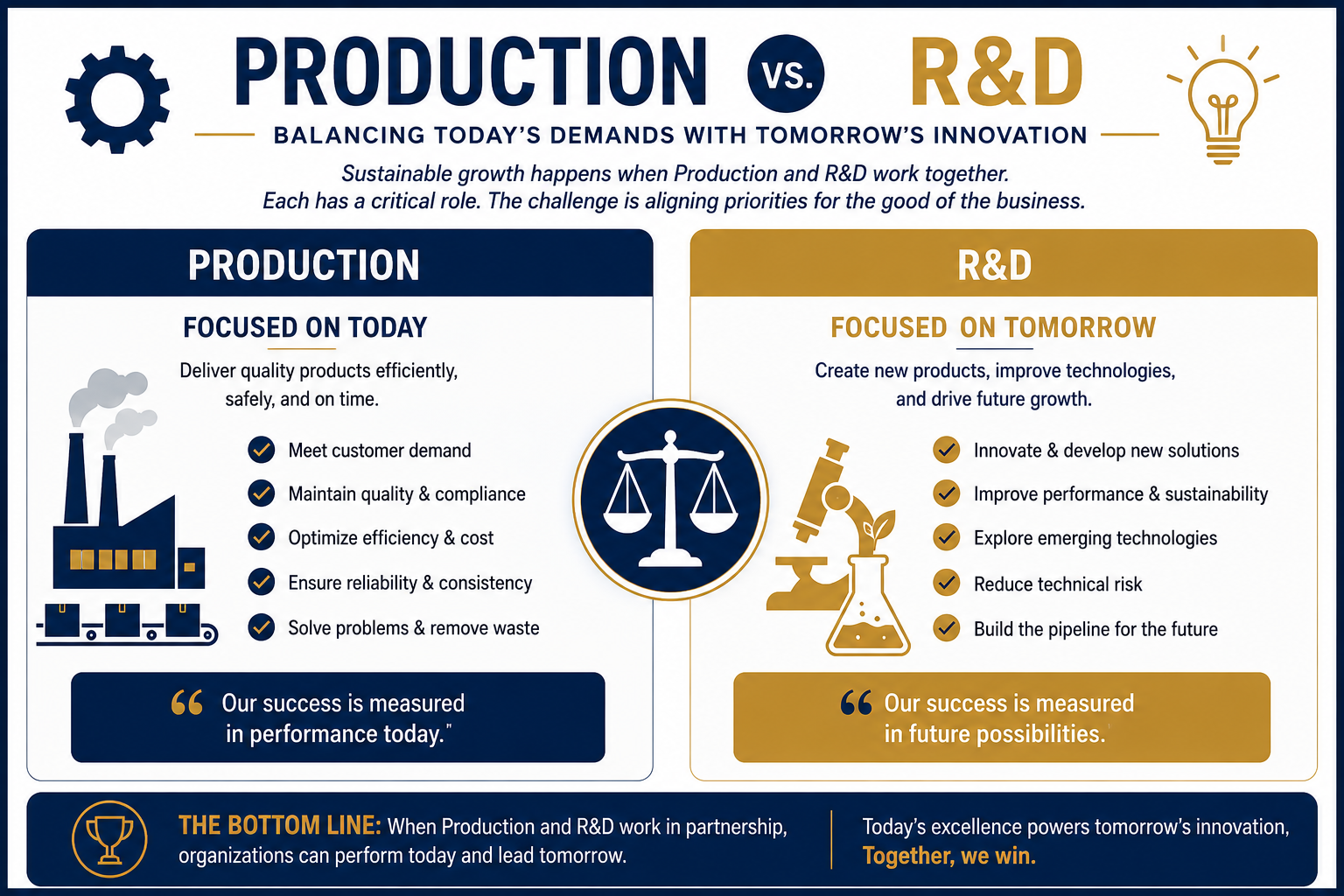
In manufacturing, there is often a natural tension between two critical priorities.
Commercial manufacturing is focused on delivering today’s products to today’s customers.
Research and Development (R&D) is focused on creating tomorrow’s products.
Both are essential to the long-term success of the business—but balancing their competing demands can be one of the greatest challenges manufacturing leaders face.
Two Teams, One Mission
Commercial operations are measured by metrics like:
- On-Time-In-Full (OTIF)
- Schedule adherence
- Batch release
- Yield
- Cost
- Customer service
- Inventory levels
The goal is consistency, predictability, and efficient execution.
R&D operates differently.
Success is measured by:
- Speed of development
- Learning
- Experimentation
- Technology transfer readiness
- Process optimization
- Regulatory milestones
By design, R&D embraces change. Commercial manufacturing works hard to minimize it.
Neither approach is wrong. They simply serve different purposes.
The Challenge of Shared Resources
Many pharmaceutical facilities lack dedicated development suites or pilot plants, leading to shared resources among commercial and development work. This can create conflicts, such as whether production lines should halt for engineering batches or if labs should prioritize stability testing for new products.
Daily decisions often become reactive without a structured planning process, impacting strategic operations.
The Cost of Focusing Only on Commercial Production
When customer demand is high, it’s tempting to focus all resources on manufacturing. This might boost short-term production output but can stifle long-term innovation. Delayed development leads to postponed product launches, resulting in missed revenue opportunities. Organizations that continually neglect development may end up with robust manufacturing but a weak product pipeline.
The Cost of Prioritizing Development Over Customers
The opposite is equally true.
If development activities continually interrupt commercial production, organizations risk:
- Missed customer commitments
- Increased changeovers
- Reduced equipment utilization
- Higher operating costs
- Lower schedule adherence
- Employee frustration
Customers expect reliable delivery.
Protecting the supply chain is essential.
Finding the right balance is the challenge.
Planning Makes the Difference
Organizations that manage balance effectively do not make last-minute decisions. They integrate it into their planning process through cross-functional collaboration among Manufacturing, Supply Chain, R&D, Quality, Regulatory, Engineering, and Commercial teams, enabling informed decisions well in advance of production.
Questions such as:
- Which commercial campaigns can be adjusted?
- When is equipment available?
- What inventory buffers exist?
- Which development milestones are critical?
- What regulatory commitments cannot move?
These discussions reduce surprises and improve decision-making.
Communication Is Critical
One lesson I’ve learned is that conflict between commercial operations and R&D often stems from competing assumptions rather than priorities.
Early and transparent communication fosters creative solutions, allowing for:
- Adjusted production campaigns
- Combined validation activities
- More effective equipment sharing
- Maintenance windows that support both objectives
Ultimately, communication transforms conflict into collaboration.
Technology Transfer Is Where Both Worlds Meet
Technology transfer bridges development and commercial manufacturing.
It’s not just about handing over documentation; it’s a partnership.
Development knows the science, while manufacturing focuses on execution. Quality ensures compliance, engineering guarantees capability, and supply chain secures material availability.
Collaboration from the start makes technology transfer smoother and faster.
It’s Not About Choosing One Over the Other
Strong manufacturing organizations don’t choose between commercial production and innovation. They understand that today’s production funds tomorrow’s development, and tomorrow’s pipeline secures today’s operations. Success in one area supports the other.
Leave a Reply